
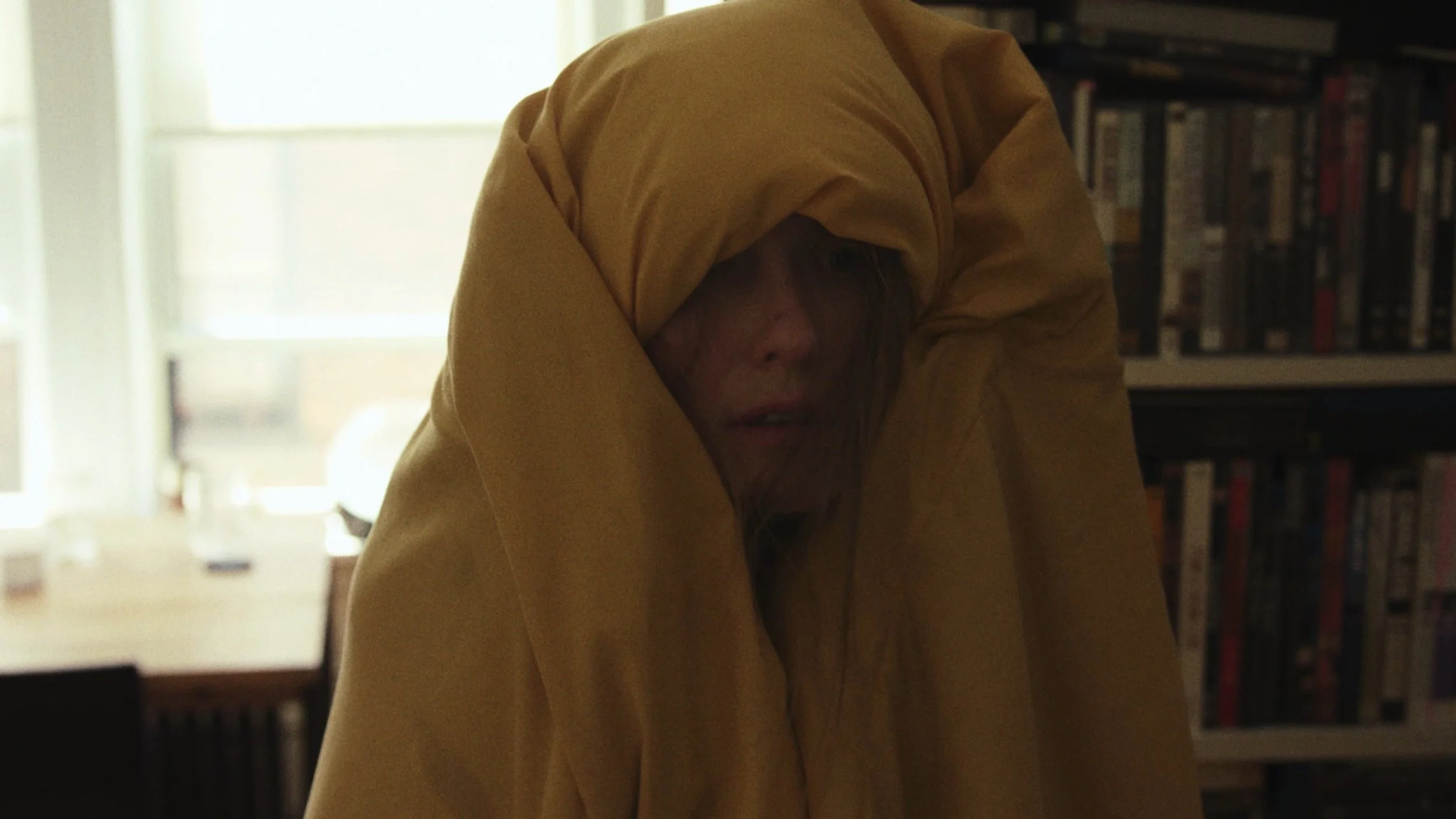

Comforter
directed by Cameron Bruce Nelson
USA. 2021. 8 min.
A woman gets so stoned she disappears.
by Jesse Knight
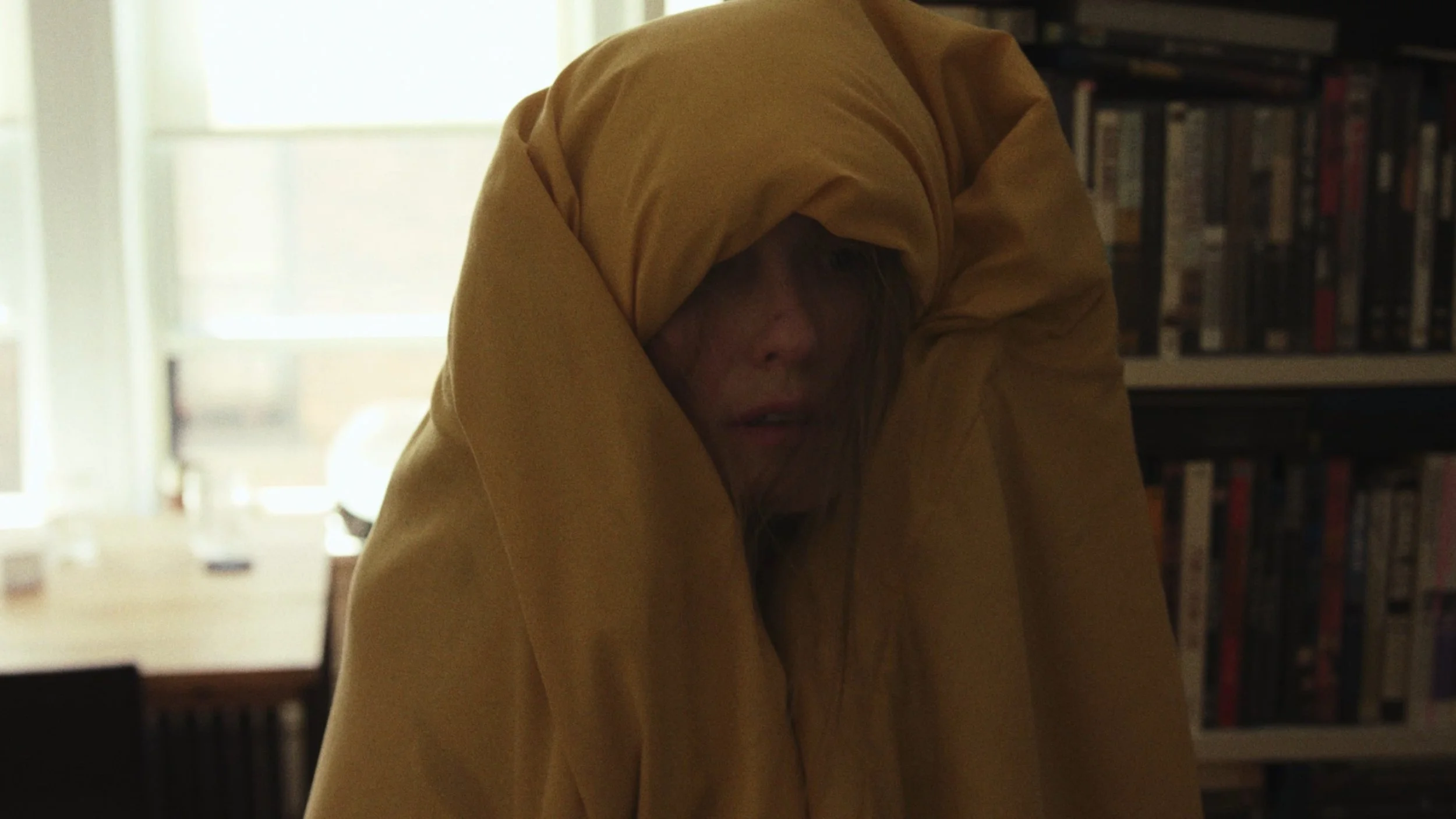
It’s rare and tricky for a film so sonically quiet to detonate an atom bomb of impact with enduring ripple effects. Such is the case with Cameron Bruce Nelson’s Comforter, eight minutes of discomfiting pleasure, with omens hanging over every second like clouds in a stormy sky. The film’s anchor is Katya Skakun’s all-matter performance: she starts out as solid, melts into liquid, and eventually becomes vapor. It’s a mesmerizing metamorphosis of physicality and wordless interpretation, transforming the entire film—just eight shots in eight minutes—into an object whose meaning bends and contorts with each repeat viewing.
I’ve revisited this film a lot over the years. Mostly to relive the experience of it, study how it works, but also to derive new meaning from it, or discover new ways to interact with it depending on where I’m at in my life. It’s a bit like a Rorschach test in that way. How’d this project come about, and what’s your relationship to it now?
Writer/director Cameron Bruce Nelson: It's funny because it had been a long time since I’d watched it, but now I realize that it was one of those rare instances where, when you have good collaborators, like Katya (Skakun), who can go into something that starts off almost like an art performance piece and then throws her entire self into it—that by itself I would have been happy with, but then, adding some devices, personal sense-memories, giving it some what-ifs in the writing of the script, which came very quickly…those elements coming together made it one of the most layered short films that I've ever done [laughs], which is weird because we made it in like two hours for a class. It was the culmination of having worked with Katya before, knowing what she can do, and then [filmmaker] Moara (Passoni) as well, and pitching them this idea. If they liked it then I knew that we were in good shape. But coming back to it, the theme of the film is actually quite personal: this want to disappear. And I wanted to exorcise that. So I centered it on this magical-realist power and sensuality of a comforter; when this character thinks they may have made a mistake and then goes through this very vulnerable moment. The seed of it was Harry Potter's invisibility cloak. I thought that was such an interesting device, just “What if it was in a different movie?” It started there, but ended up somewhere completely different. It's my mom's favorite film of mine, which says a lot about her sense of humor, but also about the personal nature of it. Maybe she saw right through it. I haven't made other films that actually have much humor in them, and I really love the humor in this. It's all in Katya and her performance. But then it goes to a wild place.
“That’s why I love short films: when it gives you an answer, but then it also opens up a trove of other pathways, and depending on who you are, you can take it in whatever direction you want to go.”
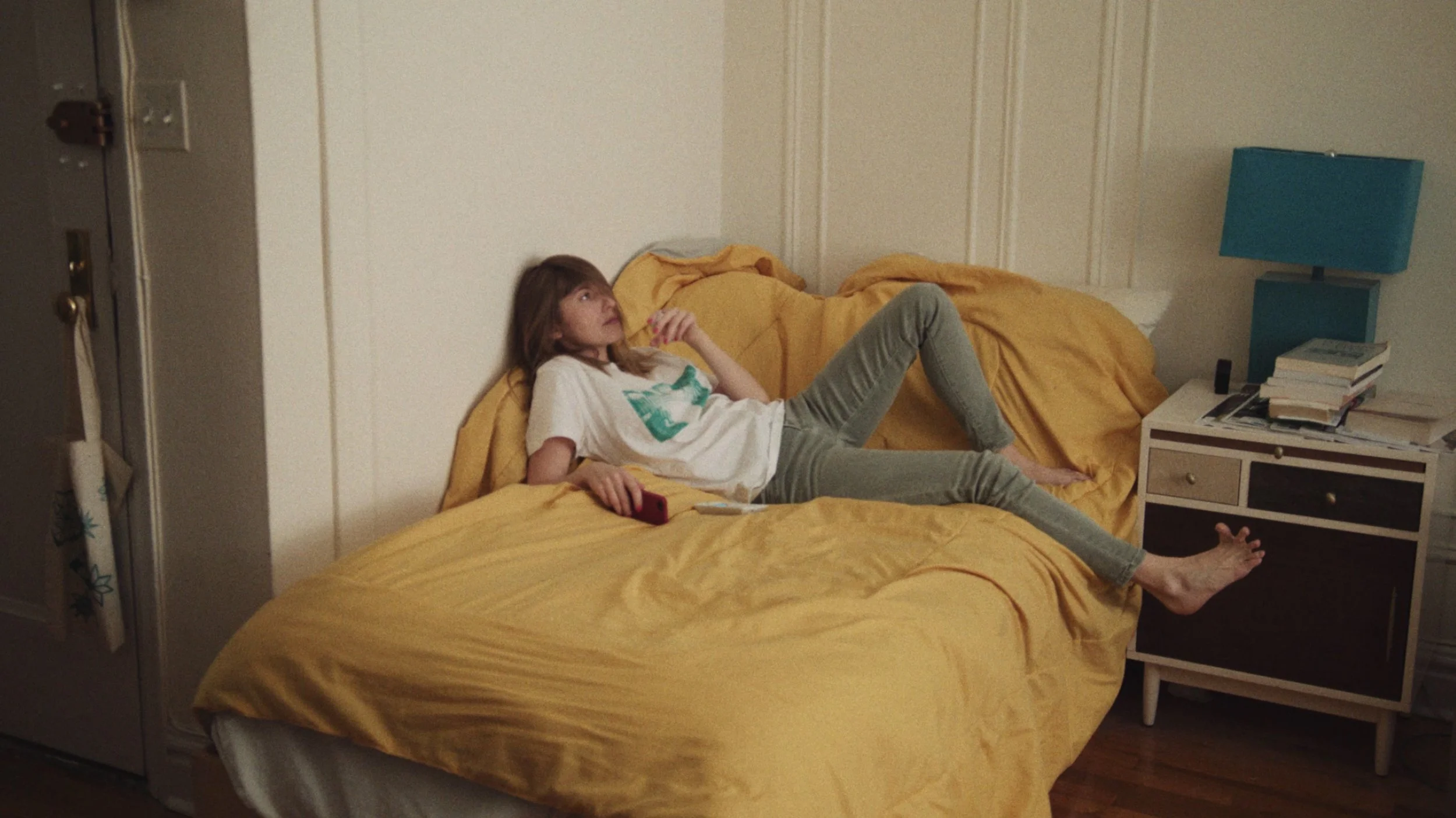
Katya is so locked into every movement. How much of that was direction, how much of that was Katya? And how many takes of that first shot did you do?
We didn't have very much time. I think it was four takes. There was a progression that we discussed before the shoot. And it has to do more with weed than direction [laughs]. It's following the feeling of getting stoned: you're getting high, you know what it feels like when the weed actually takes effect, so we just want to watch that process happen. She's starting to feel her body and then the comforter and how good it feels. I left it at that and gave her the sense of, “This is where you need to end up.” But I let her take as long as she needed because I felt like the longer it took, the funnier it would be. I knew that the rest of the film would play out pretty quickly, and we'd be able to cut, but I really wanted that first shot to be one long take.
Was that the longest take, the one that you went with, or were there longer ones?
They were all very similar. They're all about the same runtime.
“We were not really acting. We were just really present. We did some exercises, Moara as well, to become this very specific to-be-or-not-to-be state. We worked on slowing down and getting into this liminal state of mind. Not only me and Moara, but everyone on set. We would speak slowly... It was so nice being in this kind of Jell-O warm environment and just chill out. And I’m very hyped. I’m emotional and extreme. This is my personality. For me to go up and stay there is much easier than to go down and stay there.”
Is that your apartment?
Yeah. We filmed so many films in that apartment, me, Moara, and Katya. We probably did four or five films between the three of us. I always wanted to work with them because I think they're both brilliant in every way: writing, directing, producing, acting. Both of their energies are absolutely contagious and you want to just go wherever they want to go.
Did you meet them in school or did you know them prior?
We all met at Columbia. From the first year we immediately connected. Directing 1 is when I made my first short with Katya, which takes place in that same apartment. It was kind of right away. We would do whatever we needed to do to make films together. It was really nice.
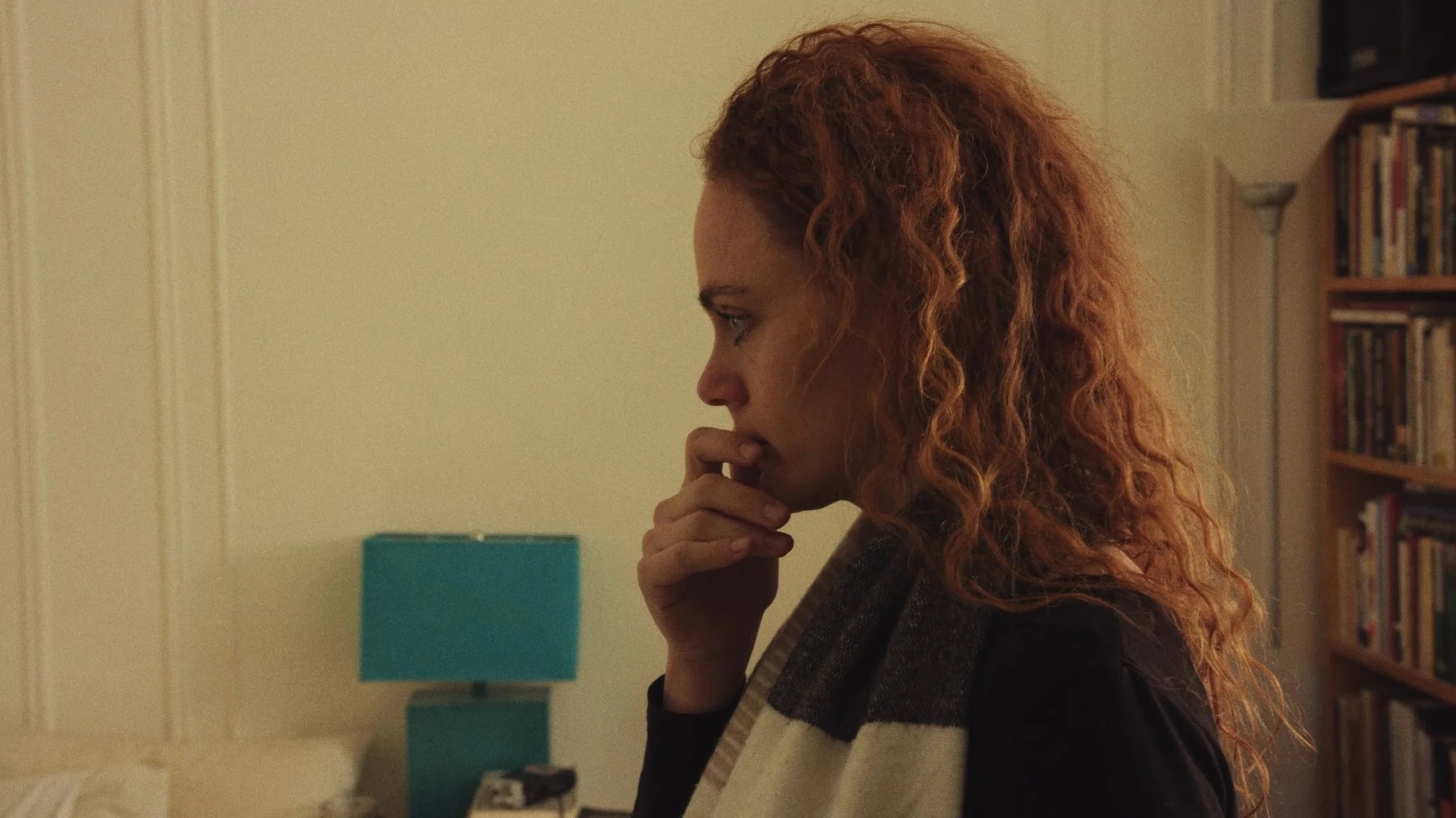
Because there are those haunting shots of the bookcase, one time I watched it I thought the film could be about a person having an existential crisis over their DVD collection. You’ve got Friends next to The Decalogue. Assuming that’s your collection. Talk about the influences on your work, in general.
Oh, man. It ranges depending on the day. I'm really inspired by Lucrecia Martel. She looms large for me. Her interest in sound and characters that make you think, “Oh, wow. Our psychological capabilities are so much more horrifying than anything that you could put into a horror film.” In a similar way, The Zone of Interest—the mundane and horrific separated by a fence and the use of the audience's imagination to fill in the gaps. Kelly Reichardt has always been a massive influence; she was the person who convinced me that I could actually make movies. I studied with [Abbas] Kiarostami. Kiarostami is somebody that I really love; Close-Up made me realize that films could question themselves. [Krzysztof] Kieslowski, of course, The Decalogue. Alice Rohrwacher. That thing of playing with time, playing with our perspective, or our perception, letting the audience make assumptions and then totally upending those assumptions. But on the Friends side of the coin, I grew up watching American sitcoms and love the formulas and artificiality of that as well, which I see in Comforter. I could go on and on. It's so funny because I showed Comforter to Ramin Bahrani—that’s whose class we made it for. He wanted to know the answer to what happened. That was tough because it's in [front of] the whole class, and you don't want to be like, “Well, here's what it is,” you know?
“It was not meant to be funny. I think it became funny because we really committed to the experience. You can always see through the film how present everyone was on set.”
How do you answer that question in a way that’s satisfying to both you and the person asking?
I always just ask them what they think happened, because it's more interesting. It doesn't shrink it down into my conception of it. I think that's one of the gifts of film is that you make something and then whoever watches it turns it into something completely unique. And [Ramin] also studied with Abbas in Iran. So, I think he understood when I said, “What would Abbas do in this situation? Would he explain it?”
Talk about your experience with Kiarostami. It's weird to have been alive at the same time as an artist like that. Studying under him must have been really special.
It was a 10-day workshop where we went to Cuba to this place that was founded by Gabriel García Márquez. It's called the EICTV (Escuela Internacional de Cine y Televisión). It's amazing. Sort of anarchic in the sense that you have all these filmmakers that have come from all over the world and have graffitied aphorisms all over their walls. They do master classes where they invite filmmakers; they fly them in, they put them up, and they teach students. In the first days there were screenings [where] we would watch his films, but then there were also two or three days of talks with him. Beyond that, he was making a short film alongside us making ours. So we all made short films together and we got to watch him make his. It was beautiful. Occasionally, he would swing by set and give pithy advice. There was one time—I met my partner there, who's from Australia—he came by her set and she was working with this 80-year-old man and he kept looking into the camera. She was like, “He keeps looking into the camera, Abbas. What do I do?” And Abbas said, “Let him.” [laughs] And then she did and it really worked! He was incredibly generous. He spoke in poetry. Just being in his presence was kind of the most important thing, seeing how he interacted with people. When he was coming from the airport on the way to the university, he kept making them stop because he wanted to get out and videotape cows. He loved filming cows when he was there. I didn't know this, but, when, I made my film about a cow; a woman who's obsessed with this cow and we don't know why, I had to pitch it to him—that was the other thing, we had to pitch to him, and we had to pitch in Spanish. His translator translated from Spanish to Farsi, and then he would go back from Farsi to Spanish. And I remember by the time I got to the end of my pitch it, he had this big smile on his face and he said (in Farsi), “I love it. Where are you from? You speak Spanish very well.” I said, “Texas.” He said, “Oh, Texas.” He knew that word in English. But it was Very intimidating pitching to Abbas in front of like 50 other filmmakers in Spanish.
“That’s how Cameron is. He’s very curious about the world. On set, if you suggest something, he’s open. I think because of that, it allows the story to contain different branches of where your thoughts can go. I really enjoyed working with him, and I miss it. He’s incredibly creative, and there’s always a feeling that something unexpected can happen.”
Back to Comforter, this might be revealing too much, but the first time I watched it I missed the ending. And it still worked. But then I watched it again with somebody and paid better attention, I guess, and seeing the ending, it was like the floor dropped out from under me. And then I found that, as I shared the film with more people, they also missed the ending. I had to tell them to go back and watch it again. It just adds another layer of trying to figure what journey you’re taking us on.
I love playing with assumptions. It's so funny because [in] the Letterboxd reviews, there's people who either hate it or love it, which is my favorite kind of film. I wanted you to assume, yes, you're just watching this woman get stoned and have this experience. By the end, I wanted to leave the audience with, “Well, you really don't know anything.” You don't know what happened in that bathroom. And if you did, then maybe the entire film that you just watched isn't actually so weird. Also, you can't make assumptions about her either because what if she's trying to deal with something? I mean, obviously she's trying to deal with something, but what if it goes beyond just the act of what could have happened. We also don't know what happened to that other person. That's why I love short films: when it gives you an answer, but then it also opens up a trove of other pathways, and depending on who you are—and maybe that's what you're talking about with the Rorschach test—you can take it in whatever direction you want to go. I love asking people, “What do you think happened to the person?” Everybody has their own idea. It could be that she's grieving. It could be that she's coping. Going back to the comforter, that's a sensation I feel like a lot of people can relate to. And it's funny because it plays in a wide shot. There are a lot of filmmakers that would go very close in—you're in it and you're claustrophobic—and I wanted the opposite of that, playing on the idea that the audience knows what this feels like. Then of course comedy plays in a wide, right? So you get the physicality of Katya's performance with it. I wanted the audience to ask, “But why? Why does she need this comforter?” I don’t know, sometimes talking about it may ruin it.
No, it just adds more layers. Because earlier you said “homicide,” which never, ever occurred to me. I just assumed it was her at the end.
That's another interpretation I've heard, which I love too. It could be homicide, it could be suicide, it could be her. That's the thing. I like to leave it unanswered. I know what I think happened. But when in life are there ever answers, you know?
Cameron Bruce Nelson is a writer/director/producer whose award-winning first feature, SOME BEASTS, screened at both U.S. and international festivals and received a physical and streaming release via Dreamscape Media.
His most recent short films, PILLARS and COMFORTER, world-premiered at the Slamdance Film Festival in 2020 and 2021. Cameron is a graduate of Black Factory Cinema's workshop in Cuba, where he was mentored by Abbas Kiarostami, and holds an MFA in Screenwriting/Directing from Columbia University's School of the Arts.
He is currently in post-production on his second feature, REWILDER, and splits time between the United States and Australia where he serves as a lecturer in Film and Television at Flinders University.
Katya Skakun is a filmmaker who grew up in a small town on the Barents Sea in the Russian Arctic and is now based in New York. She studied acting at the Lee Strasberg Theatre & Film Institute before earning an MFA in Film from Columbia University. She has participated in the Locarno Filmmakers’ Summer School, Cine Qua Non Lab, and the Cannes Producers Workshop.
Her work explores the female body as a site of transformation, moving between magical realism and the absurd. Her films examine control and the ways patriarchal dynamics persist in intimate spaces. Her recent short FOLDS received the Best Short Film Award from the Russian Guild of Film Critics and was selected for BAFICI, Palm Springs International ShortFest, and Aesthetica. As a producer, she has worked on films that premiered at the Venice and Locarno Film Festivals and screened at the New York Film Festival.