
What’s the Deal with Birds?
directed by Taylor Bakken
USA. 2025. 11 min.
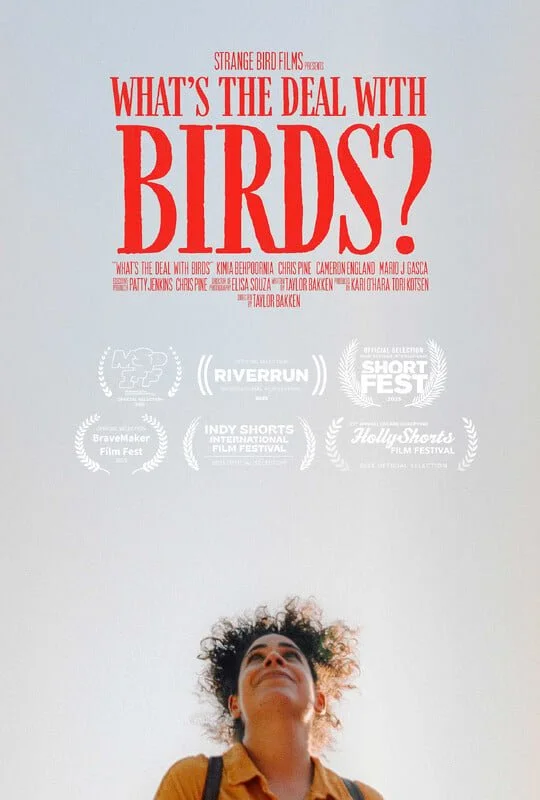
A trailblazing young birder sets out to answer the age old question: what’s the deal with birds? When a strange bird offers her answers, things begin to take flight.
by Jesse Knight
Filmmaker, producer, and visual artist Taylor Bakken’s worlds appear limitless. At times they resemble a subversive D*sney dimension, where humans are subservient to birds instead of the usual reverse. In her films, paintings, and even songs, one gets the sense that you could roam around inside them and ask a grain of sand what it’s doing with its life, and the reply would be so detailed, so aspirational, so poignant that it’d make you rethink every decision you’ve ever made that brought you to such a comparatively meaningless existence.
Shot on a temperamental film stock, combining stop-motion animation with real-world rambunctiousness, and featuring heartfelt goofball performances from Kimia Behpoornia and the voice of Chris Pine, winner of the Fun Is Good Bill Murray Comedic Shorts Award at the Twin Cities Film Festival (selected by Bill Murray himself), What’s the Deal with Birds? riffs on a trolling scientific-not-scientific article to make sense of the senseless, and in turn makes senselessness of sense.
When you begin work on a new project, what’s the first bit of inspiration? Does it start with the object and then you build from there, or the world… I’m curious where the idea starts for you, and then how do you know when it’s worth building a film around?
Writer/director Taylor Bakken: An idea slaps me across the face. I'm sitting somewhere, maybe I’m either trying to write, or I’m washing my dishes, and then it’ll hit me. It usually comes in the form of an object that I know I'm going to create something around. With What’s the Deal with Birds? it was that article. I held onto it for a couple of years, knew there was something great there, and wrote many different iterations of a story inspired by the article. Then, after working on Poolman, [producer] Kari O'Hara and I were like, "We should make something super joyful." I had a burst of an idea in my head that made me curious, and the more I uncovered, the more excited I became. Not to sound too woo woo, but I definitely believe in the vessel theory. The further along I get as a storyteller, the more I feel like I'm just receiving. It just downloads.
You’re obviously making movies, but your next short will also have a novel version, your paintings feel very much part of the same universe. Talk about utilizing different forms to express your ideas, and again, how do you know when one is a better fit for one or the other?
I try to listen to what the story wants, I think I've gotten a lot better at that over the years. For a lot of my ideas, a movie feels appropriate because I can see it as well as hear it and smell it. But the reason I want to do a novel is because I find that sometimes when the ideas are too big, you have to prematurely edit to get them into movie form. And for paintings, similarly I went through this whole phase where I was painting a bunch of fruit and getting out a lot of really crazy surrealist ideas through that, and that ended up becoming [my new short] The Carrot in a lot of ways. I think I've just fully leaned into this process where I try to listen to what the story wants or what the image wants and try not to be too precious or egotistical about where it should come from or what it should become right away.
What was it about the article that inspired you to make a movie out of it?
Daniel Baldassarre, an ornithologist, published an article called “What's the Deal with Birds?” on a specific scientific website to prove that they weren't checking anything before publishing. It made waves in the scientific community. Usually these articles go through really rigorous checks and balances, but this website was just putting up anything anyone sent in. The article was hilarious. It was like, “Penguins are weird. What's up with that?” Really wonderful and very silly. My college friend Rachel Graham, who’s a geneticist, had seen the discourse and sent the article to me thinking it was up my alley. She couldn’t have been more right. I reached out right away and got a handshake deal.
“We certainly did everything hard mode with this one, but I wouldn’t change it for the world and I think everybody learned a ton doing it. It’s a nice badge of honor. [Director of photography] Elisa [Souza] was running around in 95-degree heat with a 50-pound camera on her back. It was bonkers. But we survived.”
I love things that are irreverent and silly. Chris Pine said something on the set of Poolman that really stuck with me. We were doing a costume test a couple of days before our shoot, and he walked in wearing his red swim trunks and the really long bleach blonde wig. We were all like, “Looking good, Chris.” He shrugged and said, “I just followed my giggle.” Insert brain explosion gif. That was when I went back into the article and was like, “What can I pull from this that makes it even sillier?” But with a lot of heart, too.
What were you looking for with casting, and what did these actors specifically bring to their roles?
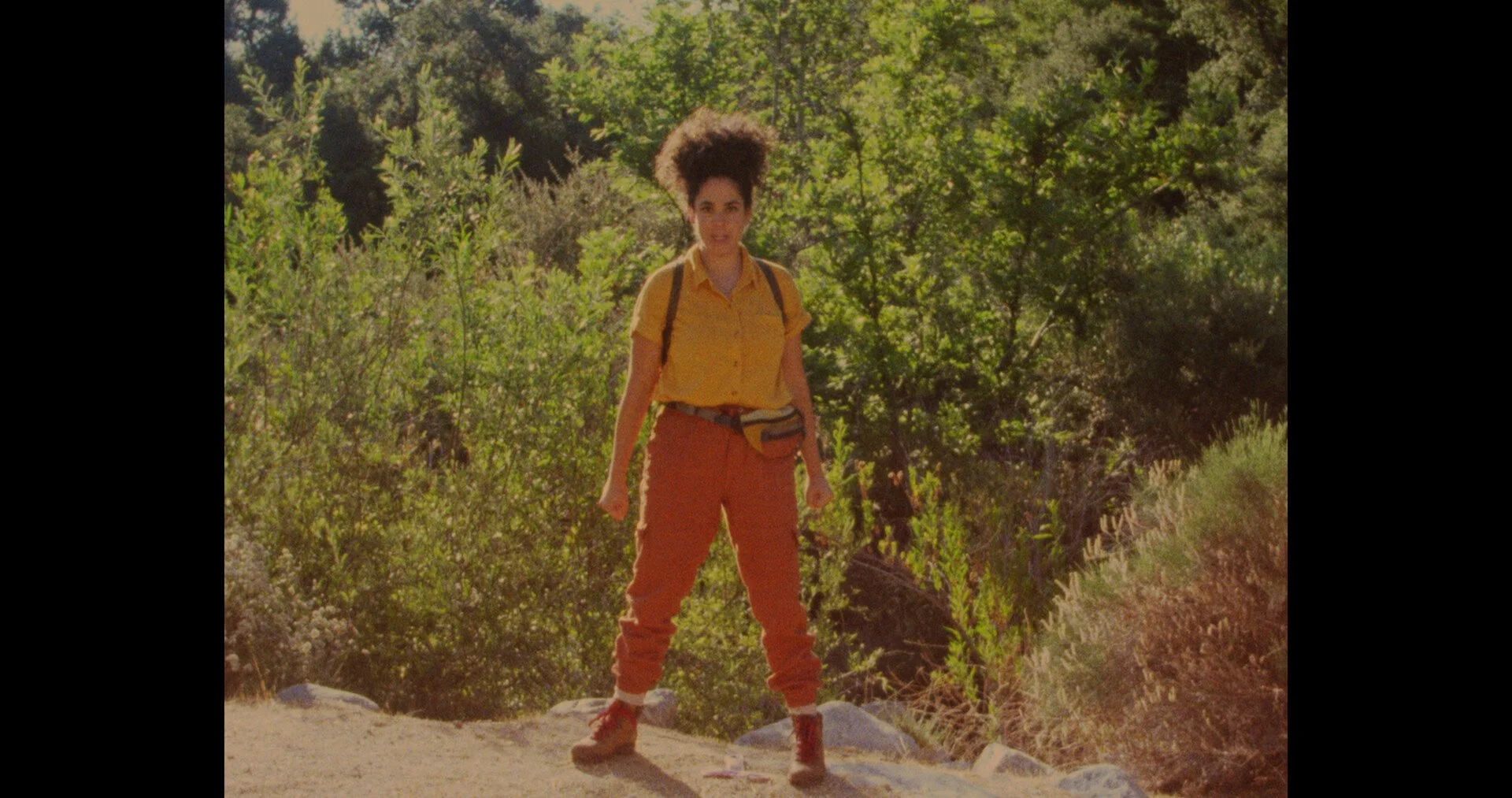
It was really interesting casting Frankie because I originally wrote it for a male in the lead role. We had a lot of conversations about it because we were an all-female producing team, and we were asking ourselves, “Should we be telling a story about a woman?” If we put a woman in the woods who's acting a specific way, will people just think she's crazy? What is the barometer of what we allow men—like the eccentricities of men—to get away with versus the eccentricities of women? It became really clear to us that we had to tell it as Frankie. But trying to find this level of wide-eyed madness that was still lovable was a really interesting conversation. Kimia was the perfect middle ground. She came to set and and played Frankie with such a beautiful anger, but also she's such an inherently lovable human being. I hardly had to direct her. She fully pulled it off with this stubborn, “Wait, why aren't you taking me seriously? I'm taking me seriously. You should too.” It was so strong on set.
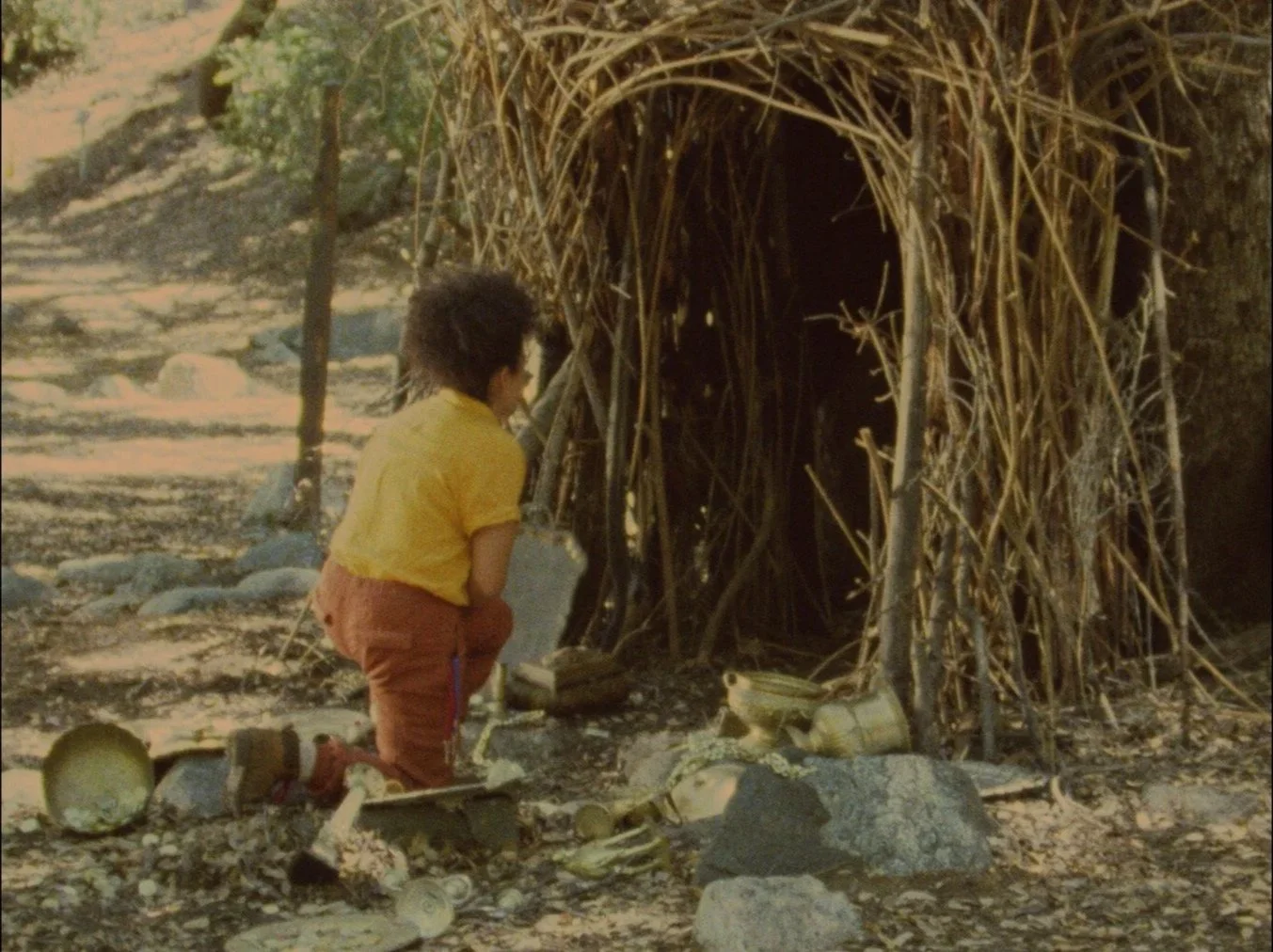
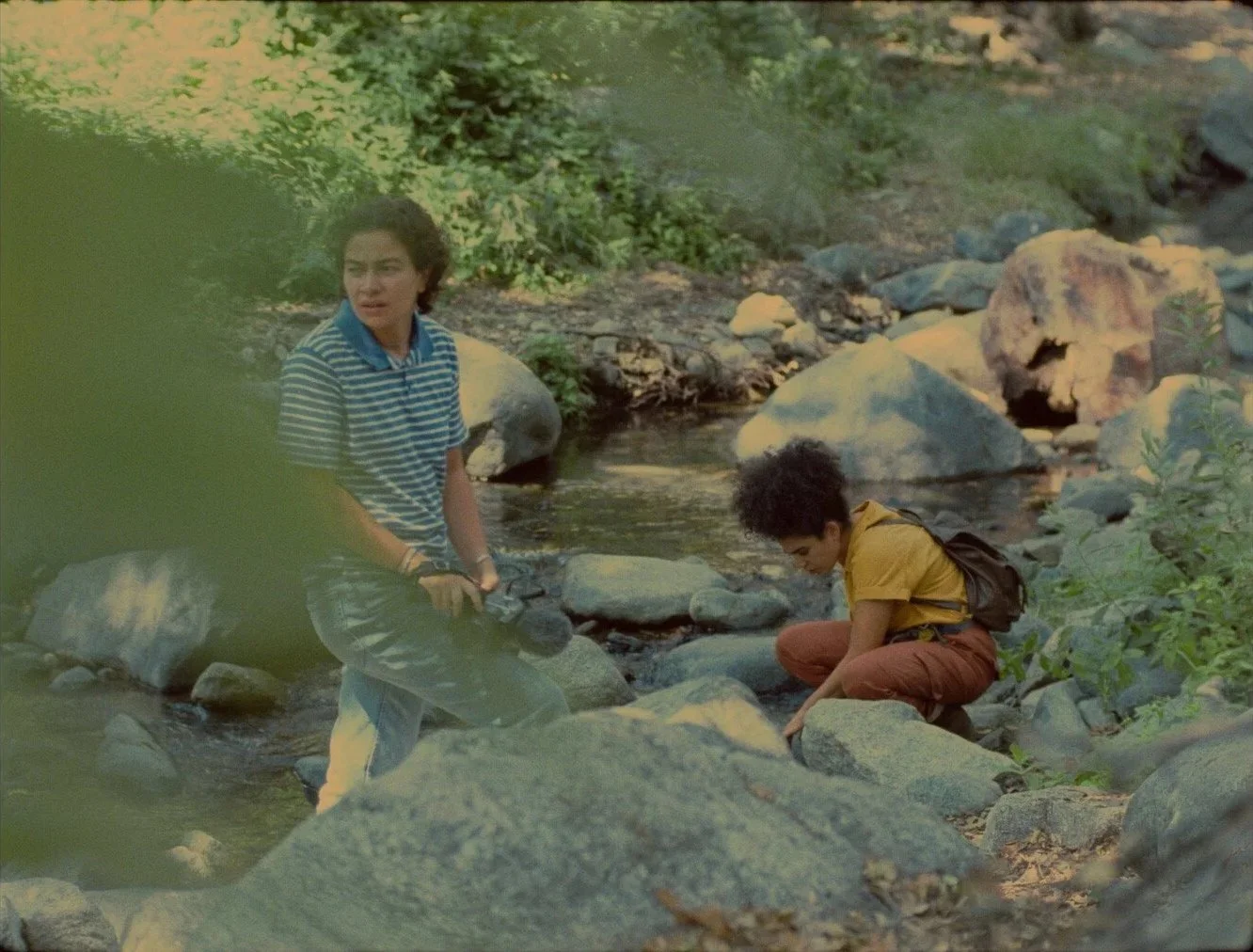
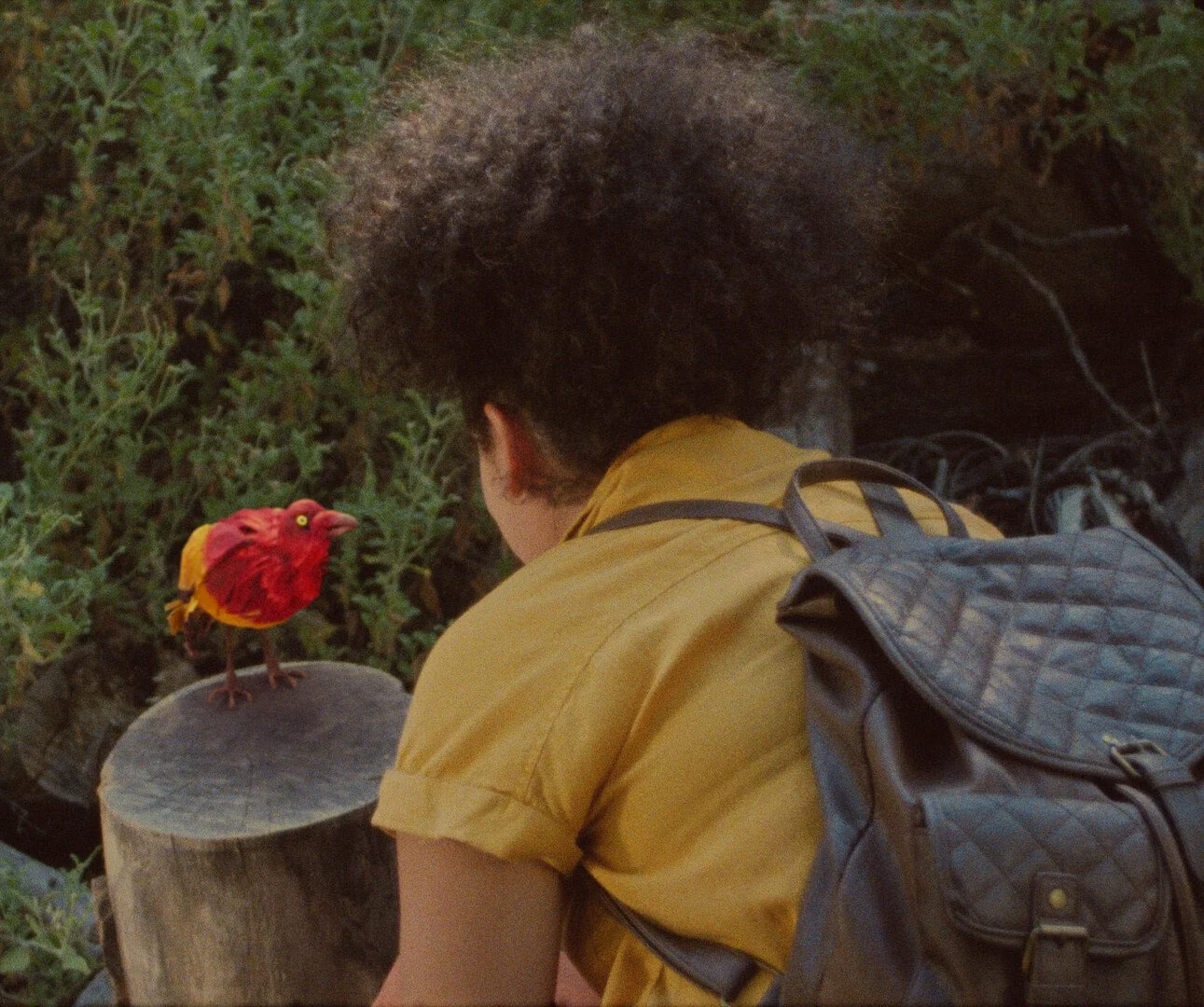
Then with Chris, we did his voiceover in like 45 minutes at his home in Hollywood. I asked him to do it like [Tom Cruise’s Mission: Impossible character] Ethan Hunt. That was my one thing. Ethan Hunt, and then Terry Gilliam animation vibes for the bigger voiceover moments at the end. I wanted him to completely change the tone so that when Frankie finally meets the bird, it’s the first being to take her seriously, and I don't know of a more serious human being or character than Ethan Hunt saying, “This is what you're going to do for me.” We had a lot of fun with it. I got really lucky with casting. Cameron England, too, as Camerakid, was such an amazing discovery for us. I've cast them again in [my next short] The Mushroom Man, and whatever I’m writing I always have Cameron in mind for a role.
What went into creating the visual style and all of these wonderful details?
It was really interesting for What’s the Deal with Birds? specifically because we shot on 35mm Ektachrome and then we cross-processed it. We got some stock and went to Panavision and tested a whole row of colors. A bunch of swabs and fabrics. We picked what Frankie's costume would be based on how the colors looked on film, because white, for example, was way too bright. Originally I saw her in this sort of jungle-esque white linen shirt and brown pants, but it was very clear that that wasn't going to work for us and yellow turned out better. For the bird design, I had done some research on birds with crazy mating habits. I emailed Daniel, the writer of the article, and asked, "Is there a bird that builds something really crazy that humans can't understand?" He responded in literally ten seconds and said, "Oh yeah, the bowerbird." The flame bowerbird is what we ended up latching onto, which is what the hero bird is. They have a wild mating dance and they build this whole thing with trinkets all over the place. I couldn't have written it myself.


What was the animation process? What were the challenges?
It was crazy. Not only did we choose to utilize stop motion animation, but we were also shooting on Ektachrome film. Our VFX supervisor [Stephen Burchell] (who ended up becoming the animator) would come on set and for every single shot with the bird, he would put on this crazy magic show where we would roll the film for a few seconds and he would pull out a silver ball, throw it aside, and then do all the cards with all the colors and the grayscale. That's what we did on set, and then he animated within two weeks, which was pretty crazy and very gnarly for our turnaround. It was amazing watching him do it. We also animated in CGI first so I could approve all of the animation, and then Stephen matched it frame for frame.
Why Ektachrome?
I knew I wanted to shoot on film, it was really important to me. I ended up meeting with Kodak at the perfect time when they had some Ektachrome stock that hadn't passed a QC test. Also, I originally wanted to shoot on 16mm, but the Ektachrome is 35mm, so we actually shot on two different camera bodies. We had a four-perf camera and a two-perf camera because the two-perf made the grain bigger and look more like 16mm. But no one ever shoots on two-perf, and that camera kept breaking down on us, which was a whole thing. It all turned out perfectly though, and the shots that I needed or the takes that I wanted to use were great. In post, working on Ektachrome is an incredible lesson in color theory. When you cross-process it, everything turns out blue. I still don’t understand how [colorist] Rory Gordon got everything to look so beautifully vibrant and red. We certainly did everything hard mode with this one, but I wouldn't change it for the world and I think everybody learned a ton doing it. It’s a nice badge of honor. [Director of photography] Elisa [Souza] was running around in 95-degree heat with a 50-pound camera on her back. It was bonkers. But we survived.
Why is it a badge of honor to use it?
It's really rare and also an incredibly tricky stock. Ektachrome is a color positive stock because it was developed in the ‘70s for nature photographers to be able to go out and only develop their stock once. But that means the color is really—if you do it the normal way, which is not the way we did it—the colors are very purpley and very red and incredibly vibrant. If you do it the cross-processed way, there's a lot that can go wrong. With light metering, we had to work really closely with my gaffer, Ryan Kuna, [and] did so much testing because Ektachrome is incredibly hard to light. It's a very finicky, very sensitive stock. That's why it's a badge of honor to use. I didn't realize this at the time, because when Kodak said, "Yeah, we’ve got this stock." I was thrilled, my dream of shooting this on film was going to happen. But Elisa was like, "Taylor, we need to talk about this." Now, looking back, I understand why she had that reaction. But it worked out fine for us.
Did you know prior that it was used for nature photography?
No. It was a crazy thing that all of my references were vintage Nat Geo photos. That was what I wanted, and then it ended up becoming this thing that was so attainable for us, which was really crazy to have fall into our laps.
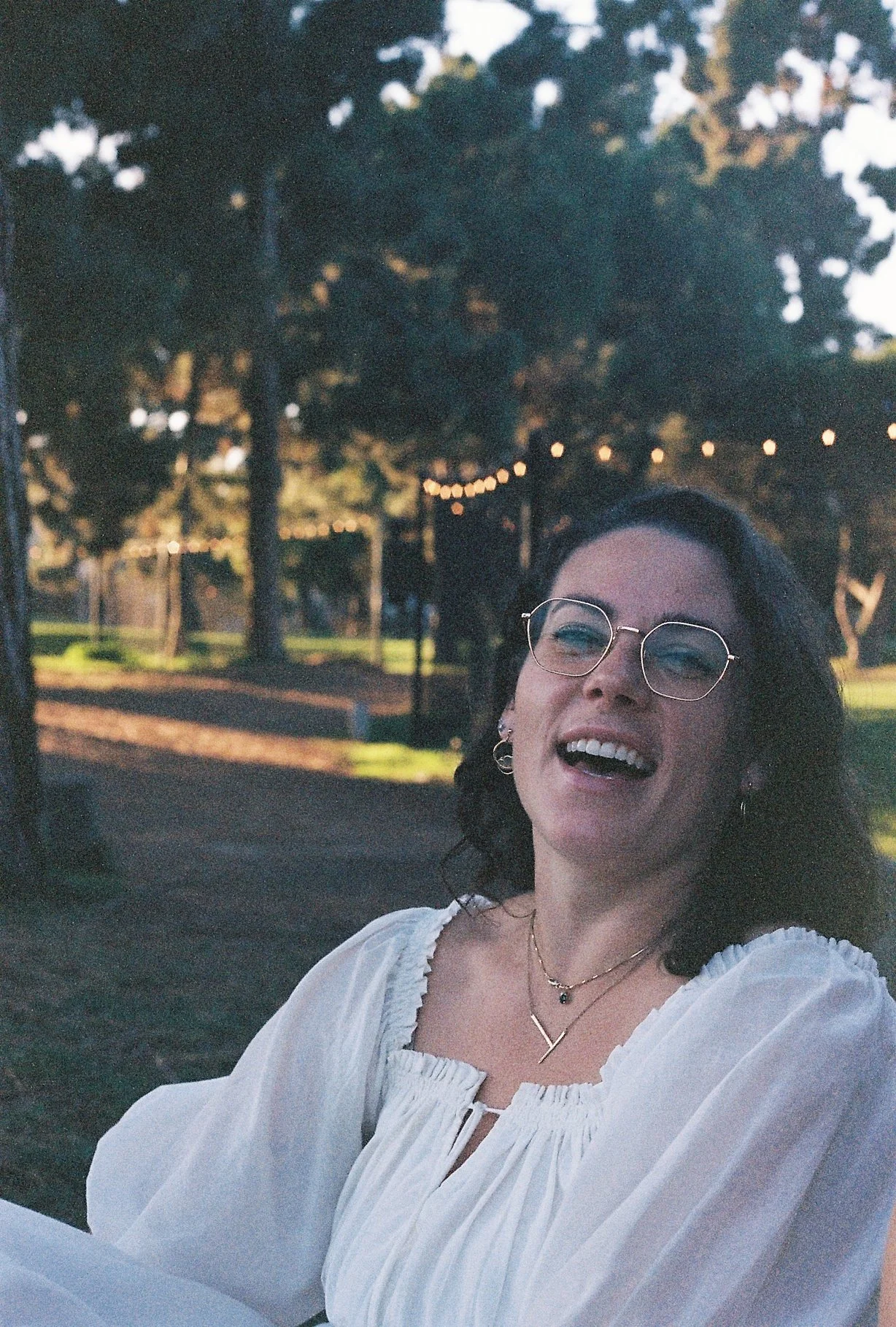
“I find so much of my own life is me trying to find more joy, or being on the dopamine-hit journey of trying to find it. So I inevitably end up telling stories where either people are trying to find it in their own lives, trying to hold onto it, or trying to give it to other people.”
As if all that wasn’t enough, you’ve got this big song at the end. What was that decision, and how’d it come together?
The final song is probably the thing I'm most proud of in the movie. We always knew we wanted to end on some crazy triumphant moment. The soundtrack from Swiss Army Man was a really big comp for us, the montage song. I also have a music background, so I work really closely with my composer [John Schroeder]. We tried a couple of different things. We did this Ben Folds-esque song where it was really beautiful and a very sweet moment, but it just wasn't hitting right. I grew up in a Parrothead family, so I said, “What if we just put a Jimmy Buffett song underneath it? Would that work?” I know Jimmy Buffett is not yacht rock, I have been made aware of this a thousand times, but my brain went from Jimmy to [yacht rock] because John plays in this yacht rock band called Harbor Party. I saw them and thought, "What if we tried a riff on that style?” We wrote something and it was working really well, I was super excited about it, but then my producers said it wasn’t weird enough.
I really love choral music and I've always been a big fan of sacred harp singing, which is basically Quaker choir music where they all get together and sit in a circle and belt in harmony. It's not about sounding pretty, it's about the loudest possible praise. I thought maybe layering that over the yacht rock could be interested. I found this online database for Sacred Harp music, typed in “bird” and found this song called “The Bower of Prayer” and I was like, “What the fuck?” We had a bowerbird in our film and that song exists? The song was about leaving your loved ones behind and moving on. It was crazy. We took the melody and words because they’re public domain— cut to John and I singing at far ends of the room with a microphone in the middle, just screaming our faces off. Still to this day when I listen to it I think, “Wow this is maybe one of my crowning achievements.” We’re working together again on more music for my next short, The Mushroom Man, [because] it’s so fun to have a piece of music that encapsulates the film.
There’s such an emphasis on silliness and joy in your work, which always makes me realize how rare it is to see in film. Why is that important to you?
There's a bit of it just being natural to me as a delusional optimist. I think that's where I end up organically. But I also think it's really important to me because I find so much of my own life is me trying to find more joy, or being on the dopamine-hit journey of trying to find it. So I inevitably end up telling stories where either people are trying to find it in their own lives, trying to hold onto it, or trying to give it to other people. It's ever-present in my work, for sure.
Award-winning writer/director/producer Taylor Bakken hails from the land of negative-sixty degree winters and Prince, although her household was more preoccupied with the likes of Jimmy Buffett and Frank Zappa. She tells stories about strange people in stranger situations.
Taylor is a veteran of film development, having worked at Team Downey and Wicious Pictures. She also associate produced Chris Pine's directorial debut POOLMAN and William Means' debut JUNKIE. She has directed numerous short films including THE ORIGIN STORY (OF GERALD THE LEMON) and most recently WHAT'S THE DEAL WITH BIRDS? starring Kimia Behpoornia and Chris Pine, which won the Fun is Good Bill Murray Award at TCFF, chosen by Bill Murray himself. Taylor is directing her first feature TERROIR in early 2027 and is in production on her next short THE MUSHROOM MAN, which was selected for Netflix/Cate Blanchett’s Proof of Concept Accelerator Program.